Saturday, March 17, 2012

It Feels Good to Be Old at Heart

Last year a company called Circle K began an ad campaign for Geezerade in Canada. Geezerade was its usual icy slush under another name, in this case a catchy ageist name. The Geezerade campaign was so obviously ageist that it aroused a popular outcry on Facebook, where many irate older adults posted about their reaction to the ads.

As one person noted, “It’s discrimination. If there was a public ad that called young people punks and dimwits, no one would stand for it,” commented one poster. Another said, "I wrote to Circle K to express my disgust at this derogatory ad campaign. If they were to advocate any other ethnic or demographically defined group as a name for their awful product, the outrage would be biblical in proportion. But, denigrate seniors? Who will stand up and protest? I did."

And this is what is going to change pervasive ageist ads--people saying they will not stand for it and doing something about it, whether that something is picketing, writing a letter or organizing a collective protest.

Advertisers continue to use images and taglines that ridicule the appearance and qualities of older people. It's deeply ingrained in our culture. Often older women are the target. But it can change. It depends on each of us taking responsibility. Not numbing out but instead taking part in changing things by complaining, waxing eloquent, demonstrating--using the methods that have already been used and continue to be used to counter other toxic prejudices.


In a wonderful essay in Audacious Aging (a book I highly recommend), philosopher/teacher Ram Dass discusses how difficult aging is in our culture, especially for women, whose attempts to continue to pass for young "... often masks a profound despair." Ram Dass continues, " It is as if we are urged to fight, over and over again, a losing battle against time, pitting ourselves against natural laws."

Oh my dear. Pitting oneself against natural laws is such an awful lot of work. It's stressful-- and of course ineffective. I stopped coloring my hair years ago. My silver hair dates me, and I am okay about that. I even advertise my vintage. I am glad I've lived this long and I enjoy finding positive ways to embrace aging as a natural part of life. It feels more real and certainly more relaxed.

I've spent quite a bit of time musing about the fear of aging and the shame accompanies being old for many people. It's been a regular preoccupation of mine, especially over the past 2 years as I've developed the lyrics for A New Wrinkle. I wrote the song Passing for Young as a way of looking at the insistent belief that we have to appear youthful in order to be a viable, worthy human being.


I wrote Hip Hop Elder's Rant to give voice to other forms of prejudice about aging, in order to raise awareness and catalyze perceptual changes. Sex after 60 debunks the stereotype that older people are sexless. Scintillating Secrets of the Older Brain debunks the stereotype that older adults are senile. All the songs in A New Wrinkle debunk ageist stereotypes and present a pro-aging view.

I am always surprised when even in the relatively sophisticated town of Ashland, Oregon I encounter older adults who are in denial of their aging or ashamed and apologetic about being older. But why should any place be immune from that, even if its residents do have a high level of education? Ageism is pervasive and largely unchallenged. Most of us do not investigate it or look at the ways it affects our self-image or our lives. As Ronni Bennett commented recently in her blog Time Goes By, we've been so brainwashed by ageist language and images since childhood that we become "complicit in our own stereotyping."

According to a study that appeared in The Gerontologist (Vol. 41, No. 5):

In a survey of 84 people ages 60 and older, nearly 80 percent of respondents reported experiencing ageism–such as other people assuming they had memory or physical impairments due to their age. The 2001 survey by Duke University’s Erdman Palmore, PhD, also revealed that the most frequent type of ageism–reported by 58 percent of respondents–was being told a joke that pokes fun at older people. Thirty-one percent reported being ignored or not taken seriously because of their age.

Negative stereotypes hurt older people and may even shorten their lives according to psychologist Becca Levy, PhD, assistant professor of public health at Yale University. In Levy’s longitudinal study of 660 people 50 years and older, those with more positive self-perceptions of aging lived 7.5 years longer than those with negative self-perceptions of aging. The study appeared in the Journal of Personality and Social Psychology (Vol. 83, No. 2).


Don't belittle aging or being old. Don't cave into pervasive cultural stereotypes and shuffle around apologizing for being over the hill and ready for the scrap heap. Move into the authority and expertise and wisdom of your years.

Relax into being old at heart.


On that happy note, I was glad to find this wonderful statement of values by Oregon elder attorney Orrin Onkin at Ronni Bennett's Time Goes By blog recently. Brilliant! Right on! Let's create a society where our elders view aging in these ways.

• We will not be judged by the values of youth.

• We will not be expelled from work or play.

• We will not equate aging with illness.

• We will not be a subject matter for experts.

• We will not be the objects of condescension or ridicule.

• We will not be a social or economic problem.

• We will not be trivialized.

• We will not be docile.

• We will not be interned.

• We will treat our later decades as a unique stage of human development.

• We will grow and learn.

• We will integrate our social, our psychological and our spiritual lives.

• We will take care of our own.

• We will cooperate across generations to create a better world.

• We will nurture and guide the young.

• We will contribute according to our abilities.

Orrin Onkin wrote and published this Older American's Pledge.

P.S. Do you read my monthly newsletter? You can subscribe to it at www.sagesplay.com

Sunday, March 4, 2012

A Cultural Obsession with Senior Moments


Senior moments--if you're over 50, you have had at least a few of them. And don't forget it.

In case you do, there are many reminders in many forms.

Like the T shirt from Cafe Press that shows a person searching for something, with the caption, "I know it's here somewhere."

You can play the Senior Moments game, "a memory game for those who might need the practice" or get a book on senior moments, either a humorous one like "1,000 Unforgettable Senior Moments: Of Which We Could Remember Only 246" or one that focuses on memory workouts.

And of course there is a persistent attention to senior moments in cartoons, jokes and everyday conversation. "Are you having a senior moment?" (pretty soon you will be a doddering idiot, just wait and see.)

I attended a senior forum sponsored by the local chapter of AAUW a few weeks ago. One of the presenters make a self-deprecating mention of her senior moment as a way of gaining rapport with the audience. Many people grinned or laughed out loud, but I groaned inwardly.

Why? As those who know me are quite aware, I am very fond of having a good laugh. Senior moments just don't do much for me as laugh material. Instead I usually get grumpy.

Sometimes I wax philosophical. I muse, "If we lived in a culture that was more friendly towards the process of aging, I imagine I would find senior moments funnier."

As a society we view aging as a time of vulnerability and decline. You lose your teeth, you lose your mobility, you lose your social cachet, you lose your mind. Of course this is quite hilarious on some level--hilarious, highly charged and discomfiting-- and yes, we often deal with difficult things through humor.

No one wants to lose it. For most of us, this applies especially to our minds. And prevalent portrayals of aging make us very anxious about the prospect of losing our minds. The current focus on debility makes it seem that Alzheimer's or another form of dementia is inevitable. Here's the story--from the age of 65-80, 5-7% of older adults become ill with Alzheimer's. That means 95-93% of older adults do not have dementia.

After 80, the risk increases to 50%. None of us want to be afflicted with dementia. I think our obsession with senior moments is related to that fear.

I was thinking the other day about how it's okay for black comedian Chris Rock to make jokes about black people, but it's racist for (boring) white entertainer Billy Crystal to try to do the same thing.

I'm of that mind about senior moments. If you and I are talking and you mention your experience of senior moments, I can empathize or laugh. But if I am getting bombarded via popular culture with the senior moment phenomenon and its implications --"you are losing it, you are losing it, be afraid, be very afraid!" I am not in a friendly mood.

Of course, I have senior moments. I also have aches and pains sometimes. (I had aches and pains earlier in life, too. Didn't you?) I move more slowly and tire more easily than I did 20 years ago when I was in my youthful 50s.

But I am not interested in defining myself by my deficits. I am interested in illuminating my potential, strengthening positive character traits, healing old wounds, taking risks, and enjoying the freedom and fulfillment that's possible in this stage of life.

I love this photo of an old woman in Indonesia performing an offering dance. I prefer to engage this way, as an old woman performing an offering dance. There is no time when one is too old to create a sacred gesture. In fact, old age lends itself to engagement with life from a sacred perspective.

I wrote the song "Scintillating Secrets of the Older Brain," as a counterpoint to our cultural obsession with senior moments. It's one of the 12 songs in A New Wrinkle, a musical revue on aging.

Why focus on what's wrong? Why not focus on what's right? It feels a lot better and is much more fun overall.

As some of the song lyrics for Scintillating Secrets of the Older Brain tell us:


"New research shows cognition peaks midlife or older—
midlife or older! Cognition peaks midlife or older.

Farewell, outdated theories of the human brain!

Thinking and creating all those years
Means you’ve got dendrite density my dears
forest of dendrites in your brain—branches that shimmer
the woodlands in the younger brain are so much thinner
youth needs more time to grow a wiser mind.


Memories, insights, lifelong skills and great imagination
Brings a capacity for complex cogitation
Now everything you know is an architecture
ready to be orchestrated with a flare
that only you can muster!


And why use one hemisphere when you can use two?
Though few folks know it—that’s exactly what older people do.
Bi-lateral brain activity –a proclivity that grows with age
the stage when you gain access to life’s whole archive
holistically—synergistically—and on dual drive.


Though the subject has not made headlines yet
Don’t let that stop you from enjoying it!


Scintillating secrets of the older brain!
Let’s not forget the almond-shaped amygdala—
With time, torrential storms of feeling
that earlier sent us reeling no longer blow through town.
That’s right! Old people mellow into greater wisdom
and partly that is due to the amygdala and limbic system.
Farewell outdated theories of the human brain!


In other words,
Be erudite or recondite
be smart, be wise, embody equipoise
be an authority or a magician
be prone to flights of great imagination
raise your expectations
set aside your reservations
engage big neural fireworks
& join the celebration!"


You can read more about the fascinating new research on the expanded capacities of the older brain in Dr. Gene Cohen's wonderful book The Mature Mind. You can read more song lyrics from A New Wrinkle at the Sage's Play website.

He is a wise man who does not grieve for the things which he has not, but rejoices for those which he has.
---- Epictetus

We are all inventors, each sailing out on a voyage of discovery, guided each by a private chart, of which there is no duplicate. The world is all gates, all opportunities.

---Ralph Waldo Emerson

Friday, February 24, 2012

The Artist's Life: Blessings of Creativity

I often go to bed early, so waking before dawn is not so unusual for me. This morning I got up at 4am with a head full of ideas. Starting the day early is normal, but waking with a flood of ideas does not happen every morning. Should I be thankful for that? Probably so. And I'm thankful too for the ongoing exhuberance of my creativity.

Many creative ideas are brief visitors. They just pass through on their trajectory as they seek some artist who has an affinity with them. Some of them do stick around though in order to be womanifested.

This morning I met with a gaggle of ideas for creating T-shirts, baseball caps and mugs with positive aging slogans on them. I was thinking of them as perks for donors who contribute to the fundraising campaign that we'll be mounting at IndieGoGo soon.

I already developed one T-shirt that says YOUTH IS A GIFT OF NATURE BUT AGE IS A WORK OF ART...Perhaps I should do more of those, I thought. How about a t-shirt that says AUDACIOUS AGING or BE BOLD! The B in bold should be a different color in order to bring the idea that one has the choice be bold in aging. I really like the idea of creating objects with positive aging remarks on them. Should we also develop a little book with photos and lyrics from A New Wrinkle, as Frannie suggested? Hmmmm....

And so I made my way to the kitchen to brew the morning coffee.


My daughter's puppy Samo stayed overnight. Now my house looks the way a place looks when there's an active toddler around--toys and a half chewed up cardboard box are strewn all over the floor. Samo's resting on the couch at the moment. When it warms up we'll go out into the garden and play out there for awhile. It is delicious to have an animal friend in my life again after more than a decade without any pets. I enjoy her visits-- though so far I have no urge to get a dog of my own.


A NEW WRINKLE'S CREATIVE MOMENTUM

During the last month I engineered three photo shoots of tango dancers, Death and Baba Yaga, to be used for publicity for A New Wrinkle. I really enjoyed getting dolled up as Death and Baba Yaga. Stepping into various personas and archetypes is a great deal of fun. What about doing it on a regular basis? a voice within me is saying. Hmmm....

I've returned to do considerable work on the script for A New Wrinkle, after a great session with my old friend playwright Carolyn Myers. I changed the order of the songs and have done major rewriting on the connective between-song skits. I'm far more satisfied with the script now-- but I'm sure it's still in the development phase.

I have to laugh when I recall starting in on the revue in January 2008 and saying perkily to Carolyn that I was sure it would be ready for production by June. She arched her eyebrows ever so slightly, looked at me straight on and said, "I don't think that's very likely." Of course, she was right. I was naive, overly optimistic and just plain unaware of what it would take to work in a completely new medium, or what a sizeable project I had undertaken.

Thankfully, in spite of an old habit of impatience, I have been enjoying the learning curve, the people I've been meeting and working with and the experience of the revue's organic development.

The garden is another creative endeavor that I find rejuvenating and satisfying. Over the winter months, I've done pruning, digging up ivy roots, enriching the soil and I've even moved plants and planted a few new ones.

I have a red wheelbarrow. When I used it this morning it reminded me of the famous poem that William Carlos Williams wrote about a red wheelbarrow.


so much depends
upon

a red wheel
barrow

glazed with rain
water

beside the white
chickens.


William Carlos Williams was a renowned poet and he was also a doctor in Paterson, New Jersey --in fact he was my doctor when I was a baby. When I began writing poetry myself at the age of 11, my father used to joke that he thought Dr. Williams had thrown some poetry dust on me when I was a baby. Maybe he did. Poetry has been an essential part of my life and imagination from early on.

Here's Blackwater Woods, a beautiful poem by Mary Oliver


P.S. I have posted some of my writing on the Sage's Play website, and you are invited to take a look at it if you wish. Selections include several poems from Carrying a Torch for the Old Flame, the introduction for Songs of the Inner Life and some articles I've written on aging. Lyrics for the songs in A New Wrinkle are also on the site, as well as 4 mp3s of songs from the revue.

Sunday, February 12, 2012

Baba Yaga and the Archetype of the Wild, Wise Old Woman


"There's a saying in our family: Be careful calling forth the great personages of stories; they have keen hearing and are likely to suddenly appear when you least expect them..."

---Clarissa Pinkola Estes

This certainly applies to Baba Yaga. One must have a healthy respect and be prepared for surprises, challenges and strange gifts. Baba Yaga is a figure from Slavic folklore, a dark goddesss, fierce like Kali or Hecate, a wise, wild crone, a demanding figure who may set you off on a heroic task to test your mettle. That's on a good day. When she sees your potential and likes what she sees, she can extend her magic, which she is doing here with the fortunate lad Ivan.

Baba Yaga is an archetype--- which Carl Jung describes as "ancient archaic images that derive from the collective unconscious."

In The Structure of the Psyche, Jung wrote, "The collective unconscious - so far as we can say anything about it at all - appears to consist of mythological motifs or primordial images, for which reason the myths of all nations are its real exponents. In fact, the whole of mythology could be taken as a sort of projection of the collective unconscious..." Jung said.

Archetypes have sweep and magnitude. They bring us out of linear time into the realm of myth and magic.

Which explains something about the fact that Baba Yaga lives deep in a forest in a twirling house that stands on chicken legs.

Naturally I had to write about that when I created lyrics for Baba Yaga's Raga, one of the 12 songs in the musical revue A New Wrinkle.


My house stands up on chicken legs/ it twirls and never sleeps/it makes a fearful frightening sound/that gives the people creeps/ and that's alright, yes that's alright with me."

One of my longtime friends is an archetype known as Coyote Woman. I am attracted to quixotic, mischievous, magical and powerful agents of the imagination, so I suppose it's not that surprising that I invited Baba Yaga to enter my world. Some days though it seems that she appeared before I was aware that I was inviting her. Then it was obvious that I had to write her into A New Wrinkle, my musical revue on aging, as an important character. Not that Baba Yaga could ever be an unimportant character.

So far so good as far as my relationship with Baba Yaga goes. Healthy respect and good motivation help. Clarissa Pinola Estes describes Baba Yaga as, "...a representation of a great woman who sees clearly, is decisive and knows the patterns of the universe." "Confronting and integrating her lessons make the heroines stronger and wiser. In confronting her, the heroines have to listen to their intuition.
Baba Yaga is also unconfined by convention and unafraid to be herself.

In A New Wrinkle she tells us, "You found your inner child years ago, and now it's time to find your inner Baba Yaga!"


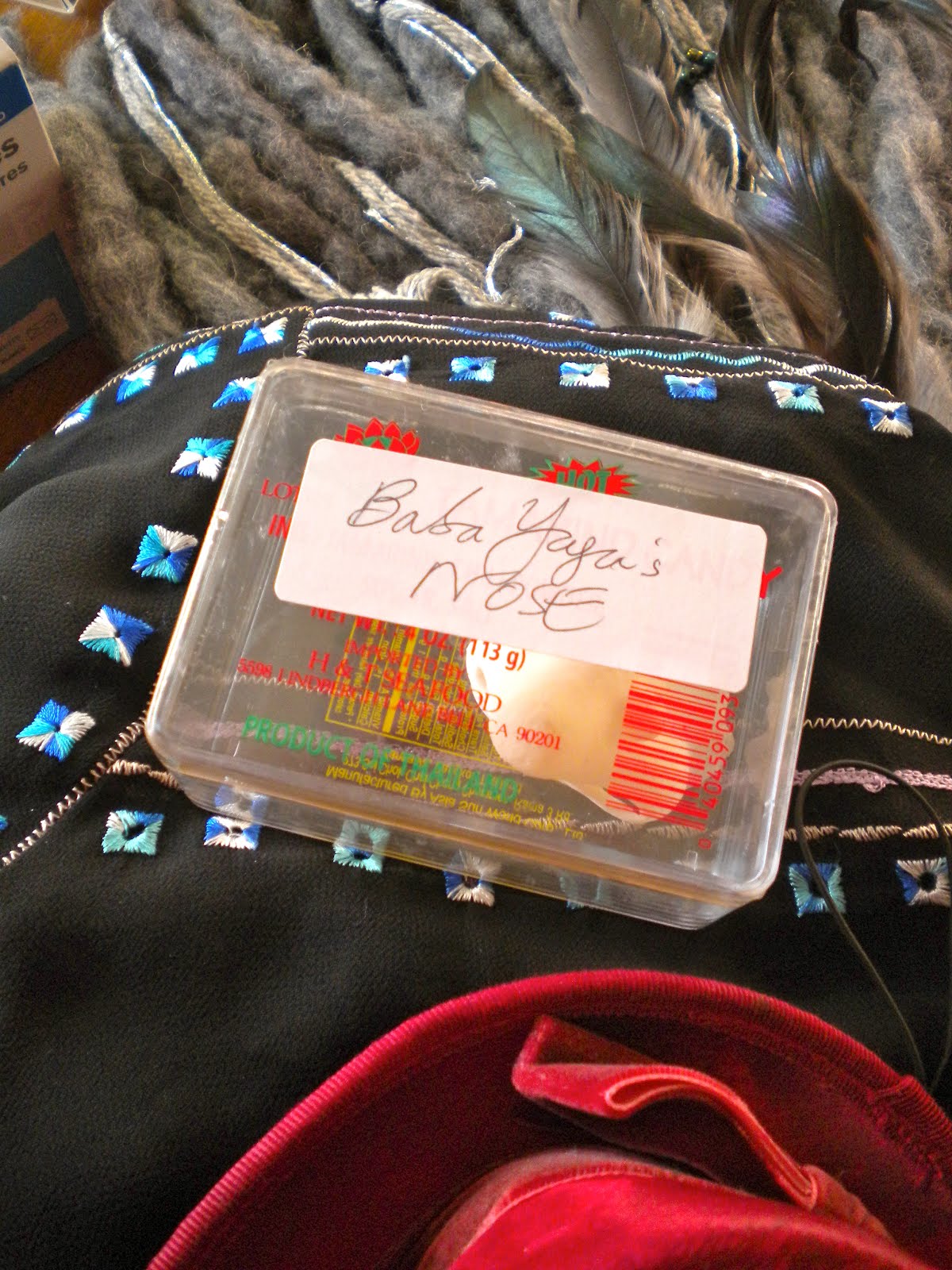
I made myself a Baba Yaga headdress months ago-- long gray dreadlocks with silver threads and feathers. I love wearing it.


Last week, a wonderful nose that I ordered arrived in the mail. Baba Yaga has a big nose and I needed one to get into character.


Here are a few of the photos that Helga Motley took in our Baba Yaga session the other day.

the heroinesT

This one is one of my favorites.


What does it say to you?

I'm interested in knowing your reaction to this image and the others here.


Baba Yaga had a very tiny tea cup that day.

These humans, they can't even remember to bring along a proper tea cup.


Bust those nice little old lady stereotypes with a powerful wise woman archetype!


I invite you to listen to the mp3 of Baba Yaga's Raga at our website www.sagesplay.com, where you can also look at the lyrics for the other song that Baba Yaga sings in A New Wrinkle, a funny song about drugs and medications.

Monday, February 6, 2012

Saturday Shenanigans with Helga


I spent two Saturdays recently with Helga Motley, a photographer I've worked with over the years on many projects.

This time we were focused on some images for A New Wrinkle.

These are a few of the photos she took at our second photo date, when I got dolled up as Death.


One of the songs in A New Wrinkle is titled Death is Right around the Corner. Actually it is a series of songs -- one of which is sung by Death himself. Death says:


Death! it’s a hard job but somebody’s got to do it.

No one knows just when it’ll come and nobody’s gonna live through it.

Imagine if you will what life is like

For me, for Mr. Death.

Folks look at me with anguished eyes

When it comes to their last breath.

They flee from me, they will not play

Not a friend on Earth, no kids at home

I’ve got no one, I’m all alone

No wonder I’m not very gay.


I like some of the images we captured. What do you think of them?


The first time we met, we focused on tango photos. Our models were Clay Nelson and Ann Berry. There is a song titled Sex after Sixty in A New Wrinkle and it debunks the myth that older adults are uninterested in sex and intimacy. What's sexier than tango? Not much.

And even though the song Sex after Sixty actually has a Carribean feel to it in the revue, the lyrics do mention the tango---

doing the tango and fandango
from here to Durango
with your well-seasoned mango!

You can take a listen to an mp3 of the song at our website, www.sagesplay.com. Lyrics are available there, too.


This coming Friday Helga and I are getting together again to get some pictures of Baba Yaga, the archetypal magic hag who provides some of the medicine and humor in A New Wrinkle. You can hear a nice recording of Baba Yaga's Raga on our website, too.

And if you don't already subscribe to our monthly newsletter, please sign up at the website while you're there in order to receive more news and updates, fun graphics and links.

Here's an item from the National Center for Creative Aging January Newsletter....I am not in this league, contenting myself with exercising at the Y, taking some walks in nature and dancing. But more power to Mr. Finch and all older athletes. Here's the news item.


Greenville Centenarian Wants to be the Fastest Man Alive

Bill Finch turned 100 last week, but he still runs a mile twice a week and plays badminton. Finch does not have a secret for his longevity, but has been active his whole life. When he worked, he ran at least one mile a day before breakfast and has continued to pursue an active lifestyle. He set the national record for the 1500 at the age of 96 and plans on running in the National Senior Games in Cleveland by which time he will be 101. “I hope I keep living as long as I’m in good health” said Finch.

January 17, 2012, Wnct.com


Meanwhile, violets are blooming in this unseasonably warm and dry winter. Hoping we get more rain soon.

Thursday, January 26, 2012

Mixed Bag: Dragons, Female Nomad, Creative Gestation


Kwan Yin Riding a Water Dragon

This beautiful image was posted on Facebook by one of my friends there. I enjoy connecting on Facebook, which at the risk of sounding hopelessly romantic, often seems to me like visiting an old-fashioned general store.

2012
is the Year of the Water Dragon

In Asia, the dragon traditionally symbolizes potent powers, particularly control over water, rainfall, hurricane, and floods. The dragon is also a symbol of strength and good luck. The year of the dragon is considered to be the luckiest year in the Chinese zodiac-- an auspicious time for the good fortune roll in! Are you ready for that? I certainly am.

Some days Facebook is more like a bouquet or a mandala. Friends post beautiful images and inspiring quotes. There are updates on people and events that the news media seldom covers, and I sometimes laugh out loud often at comments, jokes and revelations we share there. It's ironic that even though I think of myself as a Luddite, someone who prefers a slower, lowtech world, I enjoy social media and the Internet quite a lot.

A Magical House

Here's another beautiful image that appeared on Facebook the other day. It has its origin in "Old Moss Woman's Secret Garden." OMW describes herself as a Public Figure. I imagine she would have chosen Archetype if Facebook offered that option but it does not. I haven't written about my penchant for magical houses for over a year, but that doesn't mean my interest in them has been quenched in the least. And this certainly qualifies as a magical house. Of course I have become curious about Old Moss Woman-- who she might be, where she might live, and how she might be spending her days. I have been following the adventures and pratfalls of other Public Figures, notably the Republican presidential contenders and I find Old Moss Woman and her images of fairy abodes and mossy gardens quite a welcome relief from the indelicate and sometimes alarming mess.

Tales of a Female Nomad

After my daughter rearranged some boxes of books she had stored in my tool shed I found a book lying on the shed's work counter. It was titled Tales of a Female Nomad: Living at Large in the World. Most of my travels have taken place in the realms of my imagination; a well-written travel story always appeals to me. I picked it up, brought it into the house and began reading it. Tales of a Female Nomad is a story of late life liberation. Author Rita Golden Gelman felt stifled by the life she was living, surrounded by glamorous celebrities; she told her husband she'd like to travel for a month. She hoped that the adventure would change her perspective. It did. Her marriage dissolved and she began 15 years of journeying in many countries. She was in her late 50s when she began. Her style of travel is refreshing and full of instruction. It's an enjoyable read. I recommend it.


Ship of the Imagination

I found this image on Facebook too. A friend posted it recently. It's a painting by Vladimir Kush. I used it in my January Sage's Play newsletter. It captures the bouyant openness I associate with creativity. (P.S. You can subscribe to my monthly newsletter at the Sage's Play website.)

A New Wrinkle

My biggest creative event this week was a meeting that took place today with my old friend Carolyn Myers, a prize-winning playwright and actress. Carolyn describes herself as a theatrical bigamist because she participates in both the Hamazons improv comedy troupe and a second troupe, Crackpot Crones. Carolyn's creative expertise has been indispensible since I began creating A New Wrinkle 3 years ago. Three years ago! And I am still not satisfied with the script. It is not ready to share with potential producers. The songs are all wonderful, but the script needs more work. Thanks to Carolyn, whose observations and suggestions are always so incisive, I have some fresh ways to work with what I started to call the "bardos between songs."

It's magical to bring art forth from the imaginal world into the outer world. I've started staging photo shoots of characters in A New Wrinkle. It's fun. It gives me a break from the kind of focus required for working on the script and it continues the forward momentum. At the suggestion of photographer Helga Motley, I went to visit a woman doctor whose nickname is Troll. Troll has a big costume collection, a well-organized roomful of costume items of all kinds. I borrowed a beautiful cape and very tiny hat and I'm looking forward to using them soon for shots of both Baba Yaga and Mr. Death. We took some tango photos a week ago. Slowly, slowly. Patience is a virtue as my Mother always reminded me. I never appreciated that reminder as an adolescent, but now the power of duration and persistence has become more clear to me.

Saturday, January 7, 2012

Aging as a Profoundly Creative Act

This is the text for a talk I just gave at the Unitarian service in Ashland, Oregon.

Fifteen years ago, I plunged into the world of creative aging. Of course at the time I didn’t know that that’s what I was doing, as I began delving into the patterns and meaning of my life. It was the kind of exploration an archeologist makes, digging through layers that have gathered over time, finding talismans, surprising artifacts and highly charged relics. An invigorating and sometimes very heavy process traversing the terrain of peak experiences, dark nights of the soul, losses and sorrows, some of which had never been properly mourned until I unearthed them again.

A few years later, I learned that in the field of aging what I was doing had a name. It was called life review; it is considered one of the major inner tasks of aging.

Each stage of life presents us with developmental tasks and aging is no exception. What are the tasks of aging? According to Carl Jung there are 7 tasks of aging and they include:

1. Facing the reality of aging and dying

2. Life review

3. Defining life realistically

4. Letting go of the ego

5. Finding new rooting in the Self

6. Determining the meaning of one’s life

7. Rebirth – dying with life

Working on these significant assignments is an important aspect of creative aging. Older people naturally look within and reflect upon their lives. That’s why there’s something odd about the sarcastic way we hear the phrase “living in the past” used. It’s perfectly natural for older adults to reflect deeply upon the past. It’s an important aspect of the soul work of aging.

We’re in the midst of an age wave—some people call it a silver tsunami. In many countries of the world, there is a huge surge in the aging population. It’s something that has never happened before. In terms of creative aging, millions of people are investigating creative ways to remain healthy, vigorous and engaged. They’re exploring the meaning of their lives and seeking ways to share their skills and gifts.

Sharing our skills and gifts is an important role in later life. Nurturing, mentoring and teaching are part of creative aging. Psychologist Erick Erickson called it generativity. Generativity is the antidote for stagnation according to Erickson.

Cre·a·tiv·i·ty is defined as the ability to transcend traditional ideas, rules, patterns, relationships, to produce something new through imaginative skill, whether a new solution to a problem, a new method or device, or a new artistic expression. We all engage in creativity continuously. In fact, everything we do is a creative act.

Sometimes our creativity may be spelled with a big C – such as a project, a piece of art or craft, invention or idea we aim to share publicly. Sometimes our creativity may be spelled with a little c because it’s something more personal or private, like making a cradle for our grandchild, moving plants in our garden or writing a beautiful letter to an old friend.

Older adults are very creative and they have plenty of tools to do the job. To begin with, it is a highly creative act simply to be. As author Henri Frederic Amiel says, “Every life is a profession of faith, and exercises an inevitable and silent influence.”

Just being yourself is a creative expression. And by the time people are in their 60s, 70s, 80s or older they usually have perfected the art of being themselves. They’ve spent many decades in developing the maturity of their character, refining their values, polishing their skills, acquiring their unique point of view and way of being and last but certainly not least, older people often have relaxed considerably about what others think of them.

In those ways, there’s a kind of freedom that didn’t exist earlier in life. Not only that, but as one grows older one naturally has more of a panoramic perspective based on life experience and perhaps a certain amount of detachment from the immediate hustle and bustle. These qualities are some of the artistic tools that older people bring to creative aging.

Studies report that generally people are happier in later life than they ever have been before. I know that’s true for me and it may be for you, too. What is more creative than happiness? When we are happy, the good feeling radiates out like a beautiful gift to others. It is rather amazing that older people are so happy, considering the significant challenges all of us must undergo—illness, fixed incomes, the loss of loved ones and facing our own death among them. It’s rather paradoxical isn’t it, how as our bodies begin to give way, the spiritual aspects of our beings shine out.

The Creative Age is my favorite book on creativity in later life. It was written by Dr. Gene Cohen who until his recent death was director at the Center on Aging, Health & Humanities at George Washington University in Washington, DC. Dr. Cohen conducted a twenty-five year study on creativity and aging with more than 200 older adults.

“Expressing ourselves creatively can actually improve health, both mentally and physically,” Dr. Cohen said. “Creativity is a natural, vibrant force throughout our lives--a catalyst for growth, excitement and forging a meaningful legacy.” he added.

Some other points Dr. Cohen made about the value of creativity brings to wellness include these:

· Creativity reinforces essential connections between brain cells, including those responsible for memory.

· Creativity strengthens morale. It alters the way we respond to problems and sometimes allows us to transcend them. Keeping a fresh perspective makes us emotionally resilient.

· Capitalizing on creativity promotes a positive outlook and sense of well-being. That boosts the immune system.

· Having an active, creative life makes it easier to face adversity.

One of the beautiful freedoms of later life is the chance to investigate parts of ourselves we never had time for when we were busy working and raising our families. We can find great pleasure and refreshment in exploring something completely new, or finally returning to try our hand at something that fascinated us earlier in life, whether it be singing, dancing, photography, saving Social Security or joining the Peace Corps.

Social change is a creative area that especially interests many of us these days. There are many progressive social change causes I espouse, but my particular passion is this: I want to see social change in our culture’s views and beliefs about aging and its treatment of older adults. In a marvelous book of essays titled Audacious Aging, the spiritual teacher Ram Dass notes, “Issues of sexuality, gender and spirituality have come out of the closet…even birth and death are out as well. Aging remains one of our culture’s last taboos…it’s fair to say that we live in a society that would like to pretend that old people don’t exist.”

Ooof! There are many great things about our society, but this is not one of them. What choices: be invisible and marginalized or be the butt of sarcasm and mockery. If somehow you manage to evade this personally, you’re still affected by it. You’re guilty by association because you’re old. Old was once a highly venerated word but now as applied to humans it has the air of a dirty four-letter word, even though it has only three letters. How little has changed in our society since Dr. Robert Butler coined the word ageism 40 years ago. Ageism has never become a broad social cause the way racism and sexism have—but I hope it does. Age prejudice is still dismissed, laughed at or ignored. Widespread stereotypes about aging have significant repercussions on employment, health care, and social perceptions of the value of older people. I think we underestimate the effect of this on us as individuals and as a society. The report Ageism in America from the International Longevity Center is an excellent reference for educating yourself on this issue.

It’s time for a paradigm shift, a fresh view of aging that acknowledges the enormous contributions older people make to society, to science, the arts, business, family and community. Think Arthur Rubenstein, Martha Graham, Anna Halprin, Frank Lloyd Wright, Helen Keller, Carl Jung and Robert Frost. And this is just a smattering of well-known people. Older people make immense contributions yet our society continues to engage the same old hackneyed stereotypes--namely, that aging is a terrible disease to be avoided as long as possible and that old people are useless, awful and senile. How sad it is that we limit our view of aging to biological decline, while ignoring the vivid unique presence, contributions and soulfulness of each older person. How different this is from the views of some other cultures.

As author James Hillman wrote in his beautiful book The Force of Character and the Lasting Life, “Our ideas of older age need replacement. Like a hip that can no longer bear weight or a clouded lens that does not let you see out of your own head, we need to wheel our ideas into the operating room. But replacing outworn mental habits requires both attack and stamina.”

I hope that we can bring some of what we learned from the womens’ lib movement and the civil rights movement to the issues of age prejudice in our society. Ageism affects us all, whether we are consciously aware of it or not.

It was the sting of ageism that provoked me to start creating A New Wrinkle, a musical revue on aging. As an older woman and an artist, I found I couldn’t just sit quietly in the midst of our noxious assumptions about aging and old people. I felt called to express the unsung pleasures and opportunities of aging and to affirm the beauty, power, richness of spirit and resilience of older people. I’m not trying to romanticize aging, or to deny the intense life challenges it brings for each of us. But I do want to debunk toxic stereotypes and to illuminate a more life-affirming perspective. I want to contribute to creating a more age-friendly society, and this musical revue is one way I’ve chosen to move those ideas forward.

Aging is a powerful, profoundly creative time of life. It’s a time of harvesting, inspiration, insight, sharing our gifts and passing on our legacy. Imagine a society where the young seek out the wisdom of the old, where elders are happily included and appreciated and their valuable experience, skills and knowledge is utilized fully. That’s the society I imagine. The more of us that pool our imagination and action together, the easier it will be for us to create this kind of world, and that is something which will benefit us all, no matter what our age.